Calling a plumber after hours costs more than calling one on Tuesday morning. Waiting until Tuesday morning can cost a great deal more than that. The awkward part is that the decision usually has to be made at the worst possible moment, standing in a hallway with a towel in your hand.
Here is a way to make that call quickly.
The three-question test
Almost every genuine plumbing emergency fails at least one of these:
- Is water escaping and can you stop it? If water is getting into the structure and you cannot shut it off, that is an emergency regardless of how much is coming out.
- Is the water contaminated? Sewage backing up into living space is a health hazard, not just a mess.
- Do you have usable water? A house with no water at all, or no way to use a toilet, is not a house you can wait out for two days.
If the answer to all three is reassuring, you are almost certainly looking at something that can be scheduled. A dripping faucet, a single slow drain, a running toilet, a water heater that is working but noisy: all annoying, none urgent.
What does count as an emergency
A burst or actively leaking supply line. Supply pipes are pressurised, so a failure keeps producing water until someone closes a valve. Water inside a wall cavity or above a ceiling does damage disproportionate to the volume, because drywall, insulation and subfloor absorb it and then stay wet.
Sewage coming back into the property. Waste rising through a floor drain, a shower pan or the lowest toilet in the house usually means the main line is blocked rather than the fixture. Everything you send down any drain has to go somewhere, and right now it is coming back.
A water heater leaking from the tank. The tank holds its full capacity and the cold inlet keeps refilling it. That matters much more in this part of Texas than it does elsewhere, because a large share of homes have the heater in the attic, where the water has a ceiling to travel through before anyone notices.
No water at any fixture. This is sometimes trivial and sometimes not. A closed valve is a five minute fix. A failed service line between the meter and the house is not.
Any gas smell near a gas appliance. This one is not a plumbing call at all in the first instance. Leave the building and call your gas utility or 911 from outside. A plumber deals with the appliance afterwards.
What can safely wait until morning
- A single slow drain that still drains
- A dripping tap or a shower head that will not shut off completely
- A toilet that runs intermittently
- Discoloured hot water with no leak
- A water heater making noise but still producing hot water
- A minor leak you have isolated at a fixture shut-off valve
That last point is worth emphasising. If you can close a valve and stop the water, you have converted an emergency into an appointment. Most fixtures have their own stop valve underneath or behind them.
The first five minutes
Before you call anyone, do these in order:
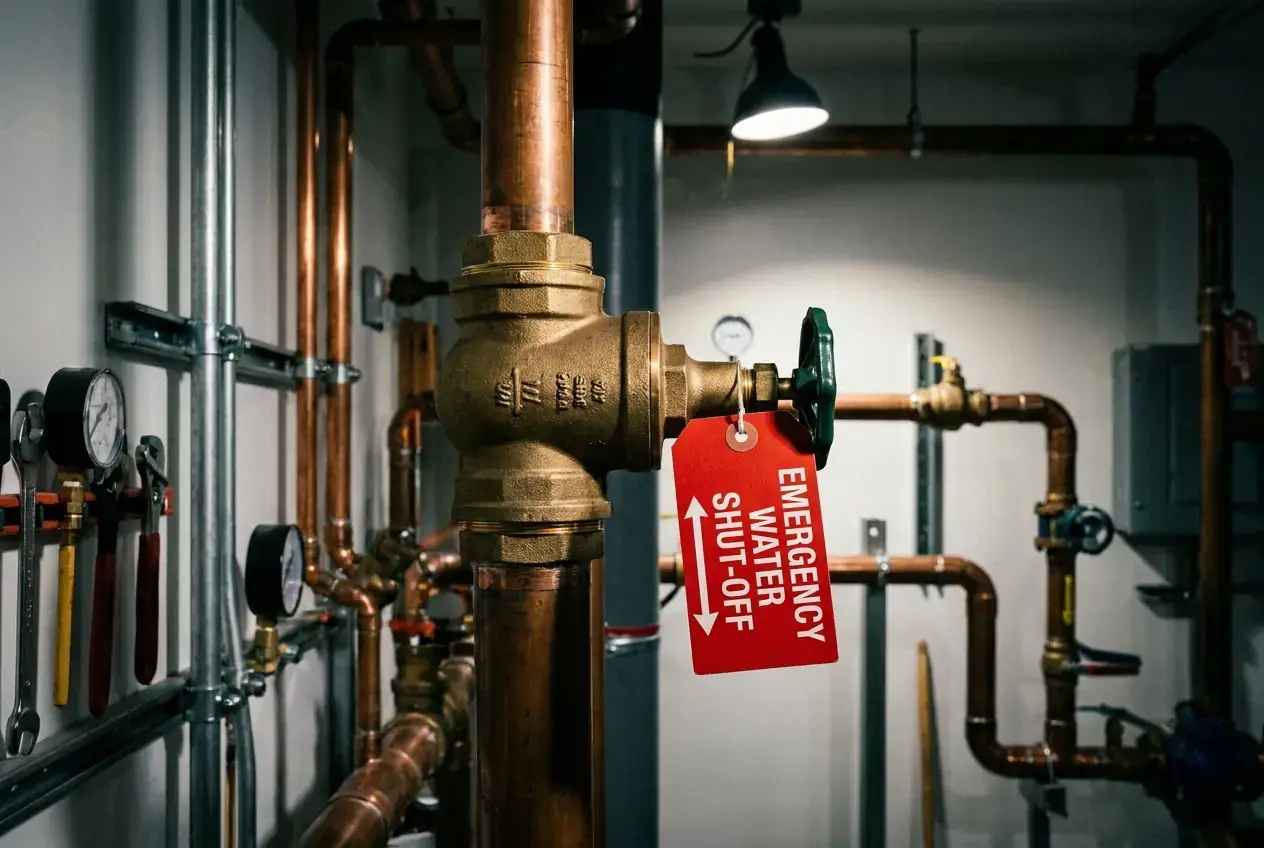
Close the water. Either the fixture stop valve if the problem is local, or the main shut-off if it is not. In most homes in this area the main is in a valve box near the street boundary, at an exterior wall toward the front of the house, or in a utility space. Find yours on a calm day and check that it actually turns. Valves that have not moved in fifteen years sometimes will not.
If the problem is on the hot side only, close the cold inlet valve at the water heater. That isolates the entire hot water system and leaves you with cold water, which is a much more liveable situation overnight.
Cut power to affected circuits. If water is anywhere near outlets, fixtures or a panel, switch off the relevant breakers and stay out of the room.
Stop using water elsewhere in the house. This matters specifically for drain backups. Every sink, shower and washing machine cycle adds to what is already coming back up.
Photograph everything before you clean up. Insurers generally want to see the damage in its original state. Ten seconds with a phone is worth doing.
What to tell the plumber
The quality of the information you give changes the response you get. Useful details:
- Where the water is appearing, and where you think it is coming from
- Whether it is clean or dirty
- Whether it is on the hot side, the cold side, or both
- What changed immediately before it started
- What you have already shut off
- For a water heater: gas or electric, and roughly how old
“Water coming through the kitchen ceiling, clean, started after the upstairs shower ran, I have shut off the main” gets a far better response than “I have a leak.”
About after-hours pricing
Emergency rates are higher than scheduled rates. That is normal across the trades and it reflects the cost of having someone available at 11pm. What you should insist on is knowing the number before anyone is dispatched. Ask specifically about:
- The trip or diagnostic charge, and whether it applies to the repair if you go ahead
- Whether the after-hours rate applies to the whole visit or only part of it
- What happens if the job cannot be completed that night
A provider that will not give you a straight answer to those questions before driving out is telling you something useful.
The honest summary
Most plumbing problems are not emergencies, and most people know it while they are talking themselves into calling anyway. The genuine test is whether damage is accumulating right now. Water inside the building envelope accumulates damage. A slow drain does not.
If you are in Prosper or the surrounding area and you are not sure which one you have, describing the symptom to someone is free. Getting connected with a plumbing professional takes a couple of minutes, and the emergency plumbing page covers the urgent categories in more detail.