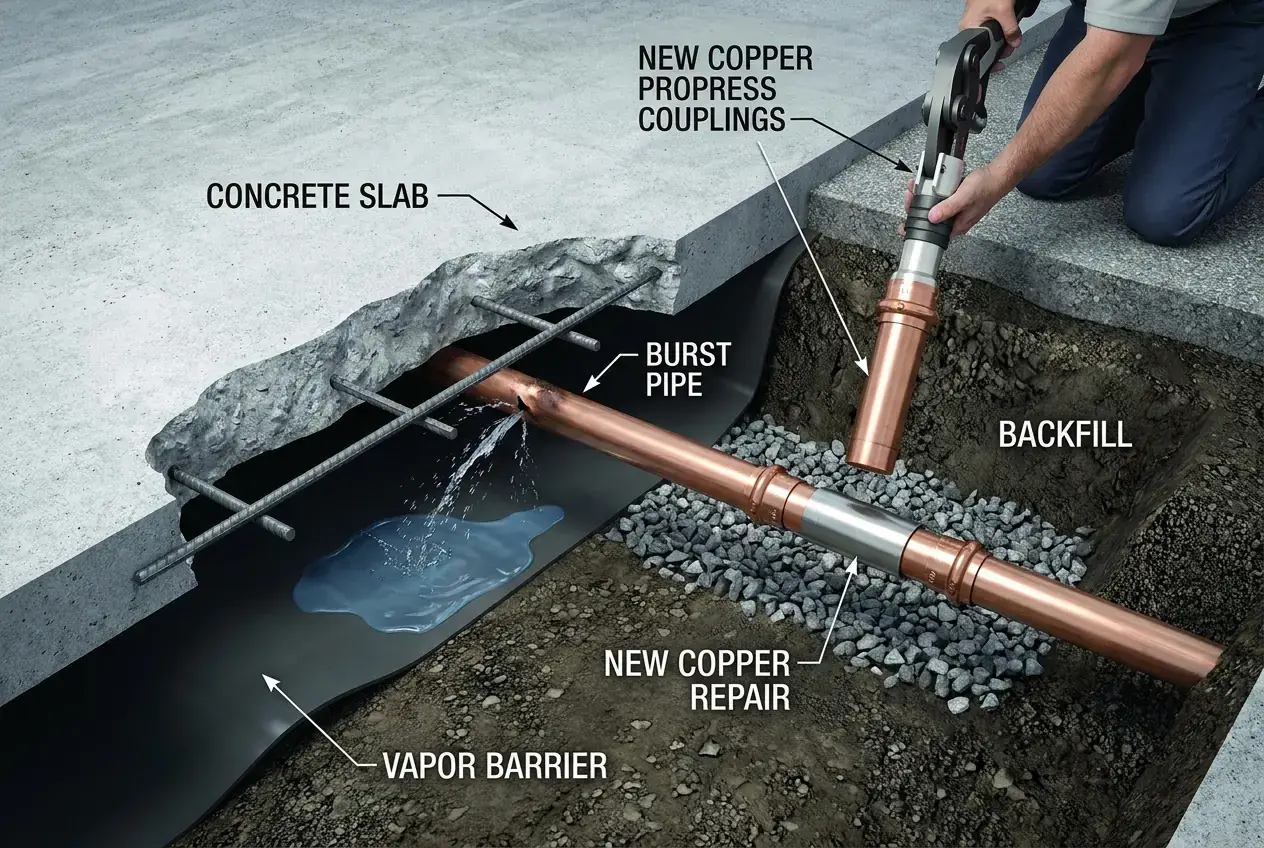
Almost every home in Prosper sits on a concrete slab, and in many of them the water lines run under or through it. When one of those lines fails, the water has nowhere obvious to go. It does not drip from a ceiling or pool under a sink. It goes into the ground beneath your house, and the first evidence you get is indirect.
That is what makes slab leaks worth knowing the symptoms of. They can run for months.
Why this region gets them
The Blackland Prairie soils across much of Collin and Denton County are expansive clay. Clay of this type takes on water and swells, then dries out and shrinks. That cycle is the reason foundation movement is such a familiar topic in North Texas.
For plumbing, it has two consequences. Rigid pipe buried in soil that moves seasonally is under recurring stress, and pipe that shifts slightly against concrete or gravel wears at the contact point. Add typical water chemistry acting on copper over a couple of decades, and you have the conditions for pinhole failures.
There is a feedback loop too. A leak under a slab keeps adding water to expansive clay in one location, which changes the moisture conditions supporting that part of the foundation. That is the main reason not to monitor a suspected slab leak for a few months and see what happens.
The symptoms, roughly in order of usefulness
A warm or hot patch on the floor. This is the most specific sign there is. It indicates a hot water line leaking beneath the slab, and it is often noticed by bare feet before anything else registers.
The sound of running water with everything off. Faint, continuous, most audible late at night when the house is quiet. Putting an ear to the floor in different rooms sometimes narrows down where it is loudest.
A water bill that has jumped with no change in usage. Compare against the same month in a previous year rather than against last month, since irrigation makes summer bills seasonal.
Damp flooring, or carpet that stays wet. Particularly in a spot that has no plumbing fixture near it.
Water pressure that has dropped noticeably. Not conclusive by itself, but meaningful in combination with anything else here.
New cracks in tile, grout or drywall. Foundation movement has many causes, and a plumbing leak is only one of them. Treat this as a prompt to investigate rather than as a diagnosis.
A musty smell with no visible source. Moisture reaching flooring materials from underneath.
The test you can run in ten minutes
This costs nothing and it is genuinely diagnostic.
- Turn off every fixture and appliance that uses water. Include the ice maker and any water filtration system, and wait for the washing machine and dishwasher to finish if they are running.
- Find your water meter, usually in a box near the street boundary.
- Look at the flow indicator, often a small triangle or dial that spins with even minimal flow.
- Note the meter reading, wait an hour with no water use at all, and read it again.
If the indicator is moving, or the reading has changed, water is escaping somewhere in the system.
Then narrow it down. Close the shut-off valve for the irrigation system and repeat the check. Irrigation is a frequent cause of unexplained water use in this area, given the lot sizes and near-universal sprinkler systems, and a stuck valve or a cracked lateral can waste a large volume with no indoor symptom at all. If the meter stops after isolating irrigation, you have found your problem and it is not under the slab.
If you can isolate the house at a main shut-off between the meter and the building and the meter still moves, the leak is on the service line between the two.
Check the toilets too. A few drops of food colouring in the tank, left for fifteen minutes without flushing. If colour appears in the bowl, the flapper is leaking. A silently running toilet wastes a surprising volume and it is a much cheaper fix than a slab repair.
What professional detection involves
Once a leak is confirmed, the job is to pinpoint it precisely enough that access can be cut in one place. That normally means:
- Pressure testing isolated sections to establish which run is losing water
- Acoustic listening equipment, which amplifies the sound of pressurised water escaping and is how most slab leaks are located
- Thermal imaging, which can show a hot water leak spreading beneath a surface
The output should be a marked location and the evidence behind it. Ask to see that evidence. Paying for detection as its own step almost always costs less overall than cutting exploratory openings and hoping.
The repair options
There are three broad approaches, and the choice is worth understanding before anyone starts.
Spot repair. Cut through the flooring and the slab at the marked point, repair the pipe, patch the concrete. Direct, and appropriate when the system is otherwise sound. It does mean work inside the living space, and the floor finish is usually restored by a separate trade.
Reroute. Abandon the failed run and install a new line through accessible space, typically the attic or interior walls. Often preferred when the leak is in an awkward position, when the buried pipe is old enough that more failures are likely, or when the alternative means cutting through something expensive.
Repipe. Replace the distribution system. Reserved for cases where failures are systemic rather than incidental.
A plumber should be able to explain why they are recommending one over another, and what happens to the price if the pipe turns out to be in worse condition once the slab is open. Ask that question in advance.
One boundary worth respecting
A plumber assesses the pipe. A structural engineer assesses the foundation. If foundation movement is already a concern at your property, those are two separate opinions and you may want both. Neither trade should be asked to speak for the other.
Insurance
Policies vary considerably. Many cover the resulting damage and the access needed to reach the leak while excluding the pipe repair itself, and gradual leaks are frequently treated differently from sudden ones. Document everything with photographs from the start and contact your carrier early rather than after the work is done.
If you suspect one
Start with the meter test. It is free and it either rules the whole thing out or tells you something worth acting on.
If it points at a leak, the slab leak repair page covers the detection and repair process in more detail, and the leak detection page covers the methods used to pinpoint it. To have someone look at it, send a request with what the meter test showed.