Most people meet this decision under pressure, standing next to a failed tank with water on the floor. That is the worst possible moment to weigh it up, because the answer that gets chosen is usually whatever can be installed today.
If your current unit is still working, this is a decision worth making in advance.
The basic difference
A storage tank heater keeps a reservoir of water hot continuously, so it is ready when you open a tap. When the reservoir is used up, you wait for it to recover.
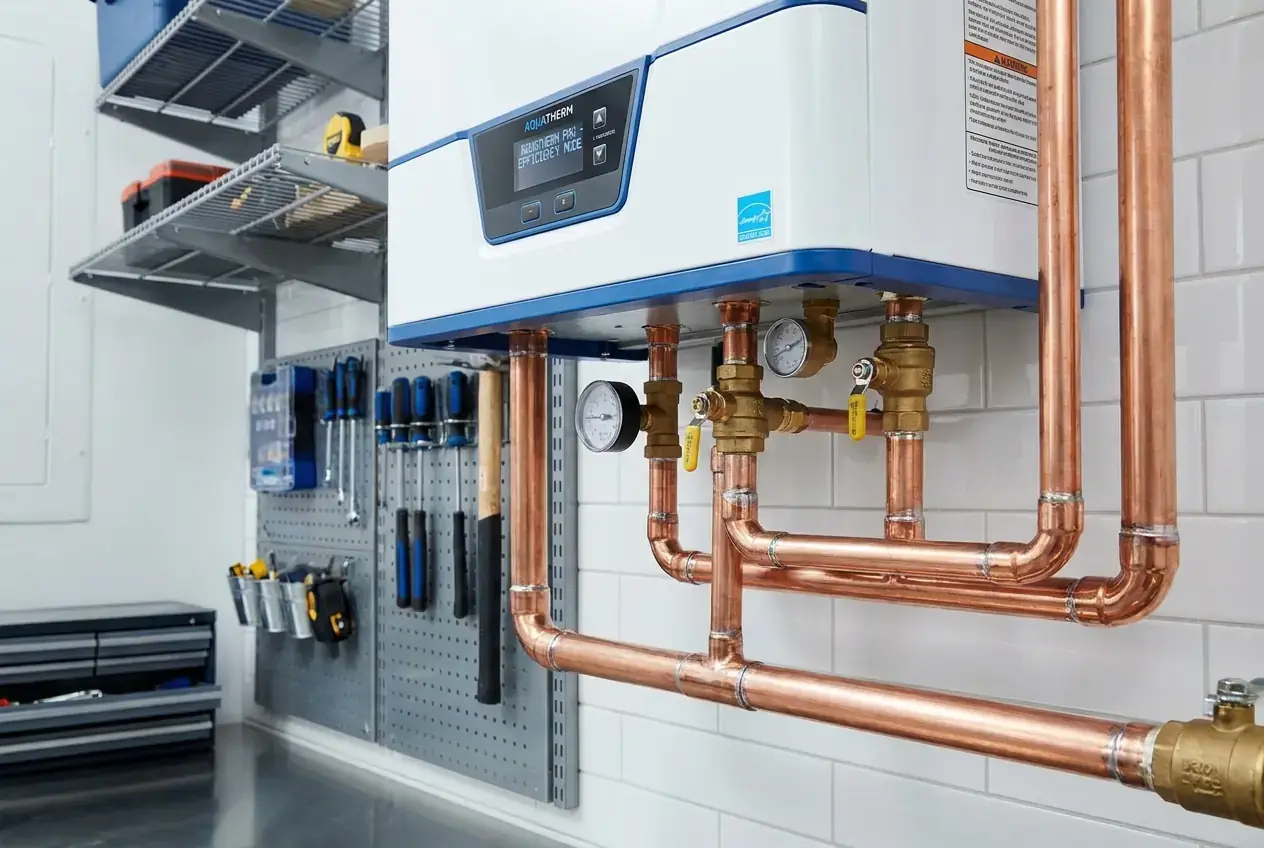
A tankless heater heats water as it passes through a heat exchanger. There is no reservoir, so there is nothing to run out, but there is a limit on how much hot water it can produce at once.
That difference produces two distinct failure modes. A tank runs out. A tankless unit cannot exceed its flow rate. Neither of those is a defect; they are just different constraints.
What usually decides it in practice
Not the brochure comparison. The constraints on the ground:
Gas supply capacity. A gas tankless unit typically demands substantially more input than the tank it replaces. If the existing gas line and meter cannot deliver it, the installation includes running a larger line, and that can be the single biggest cost in the job.
Venting. Tankless units generally need different venting from the atmospheric flue on many older tank heaters. Category III stainless or a concentric direct vent through an exterior wall is common, and that means new penetrations and new material.
Electrical. An electric tankless unit sized for a whole house has significant amperage requirements, often needing multiple dedicated circuits and sometimes a service upgrade. This is why electric tankless makes more sense as a point-of-use solution than a whole-house one in many homes.
Where the unit lives. Attic installation is common in this area. It affects access for both installation and future service, and it makes the drain pan and pan drain more important than they might seem.
Condensate. High efficiency condensing units produce acidic condensate that needs a drain and often neutralisation. Somewhere for that to go has to exist.
None of these rule tankless out. They just mean the honest quote for a tankless conversion is frequently well above the sticker price of the appliance, and anyone quoting a straight swap without discussing them has probably not looked carefully.
Where each one wins
Tank heaters are the better choice when:
- You are replacing like for like and the existing infrastructure suits it
- Peak demand is concentrated but short, which suits a reservoir
- Upfront cost is the binding constraint
- Simplicity of service matters, since parts are common and any plumber can work on one
Tankless heaters are the better choice when:
- Hot water demand is spread out rather than concentrated, so the flow rate limit is rarely hit
- The household regularly runs out of hot water with a correctly sized tank
- Floor space is genuinely valuable
- You expect to stay in the property long enough for the longer service life to matter
- The gas supply and venting situation happens to suit it
Sizing, done properly
For a tank, sizing is not a function of bedroom count. It is a function of peak simultaneous demand and recovery rate. Two showers running while a dishwasher fills is a different requirement from the same fixtures used one at a time.
For a tankless unit, the number that matters is flow rate at a given temperature rise. Incoming water temperature varies by season, and the colder the supply, the lower the flow rate the unit can deliver at your target temperature. A unit that is comfortable in August may struggle in January.
Ask the installer to show you the calculation rather than the model number.
The hard water factor
North Texas water carries enough mineral content to matter for both types.
In a tank, minerals settle out as sediment on the floor of the tank. That reduces usable capacity, insulates the burner from the water, and produces the rumbling and popping noises many people recognise. Periodic flushing addresses it.
In a tankless unit, minerals deposit as scale inside the heat exchanger, which restricts flow and reduces efficiency. Descaling is the maintenance equivalent of flushing a tank, and it is not optional if you want the longer service life that tankless is bought for. Ask whether isolation valves are included in the installation. They make descaling straightforward, and their absence makes it a much bigger job.
Cost, honestly
We do not quote work on this site, because the plumbing company doing the job sets its own pricing. What is worth understanding is the shape of the comparison:
- Tank units cost less to buy and considerably less to install in a like-for-like replacement
- Tankless units cost more to buy and substantially more to install where gas, venting or electrical upgrades are needed
- Tankless units generally use less energy, since there is no standby loss from keeping a reservoir hot
- Tankless units generally last longer, which spreads the higher cost over more years
- Both need maintenance, and tankless maintenance is less optional
Whether the running cost difference recovers the installation difference depends heavily on how much of an upgrade the installation requires. In a home where the gas line and venting already suit it, the case is much stronger than in one where they do not.
Questions to ask before you sign
- What size have you specified, and what calculation produced it?
- Does the gas line need upgrading, and is that in this price?
- What venting is required, and where does it terminate?
- For tankless, are isolation valves for descaling included?
- Is an expansion tank required, and is it included? Many homes in this area have a closed system where one is needed.
- What happens to the drain pan and pan drain?
- Who pulls the permit and schedules the inspection?
- What is warranted, by whom, and for how long, on both parts and labour?
That last set matters. Water heater replacement typically requires a permit and inspection in North Texas municipalities, and the licensed plumbing company doing the work normally handles it. Confirm the current requirement with the Town of Prosper. Unpermitted work also tends to void manufacturer warranties.
The short version
If your existing setup suits a tank and your household is not regularly running out of hot water, a good quality tank heater properly installed is a perfectly sensible choice and it will cost less.
If you are regularly running out, or the existing infrastructure already suits a tankless install, the case for tankless is real. Just make sure the quote includes everything the conversion actually needs.
The water heater replacement page goes into the installation detail. If you want someone to look at your specific setup and tell you what it would actually take, send a request.